Query
Please provide a summary of the key corruption risks and potential mitigation measures in electromobility in Peru.
Introduction
Peru has experienced political turmoil over the past decade. The current president, José Jerí, is the country’s sixth president since 2020, an illustration of the instability of the political system and the depth of the current political crisis. While the country has many problems, the current crisis is partly explained by political power dismantling from within, with electoral fragmentation, political amateurism and weak links with society contributing to politicians that are willing and able to bend or even break democratic norms to pursue their short-term interests (Barrenechea & Vergara 2023). This political situation was in part exacerbated by corruption, as the Lava Jato operation triggered investigations against Peru's pre-2016 political class (Cassinelli 2025).
Tensions between the legislative and executive branches of government are also high as three of the six presidents were removed from the presidency by the congress. Beginning in 2016, congress started to abuse its overnight powers, exploiting procedural rules to use impeachments as political leverage (Cassinelli 2025).
While political instability and external shocks have taken a toll on economic performance, the economy has returned to growth, and inflation was among the lowest in Latin America in 2024 (US Department of State 2025). The country’s gross domestic product (GDP) also grew 3.3% in 2024 (World Bank Group Data). This is partly explained by the commitment of different governments to conservative fiscal management (US Department of State 2025).
Corruption in Peru is considered to be widespread and systemic, found at all levels of government (Heuser 2018; US Department of State 2025). The country ranked 127 in the Corruption Perception Index of 2025 with a score of 30 out of 100, a drop of 8 points from its 2020 score of 38. This is further compounded by criminal structures that have infiltrated the political system and a widespread perception of insecurity (Heuser 2018). Reported extorsion increased sixfold between 2019 and 2024, and homicides doubled since 2019 (Cassinelli 2025). Lawmakers have advanced legislation that reduces penalties for certain crimes, modifies the definition of organised crime, weakens controls on political financing and limits anti-corruption efforts (Cassinelli 2025; Human Rights Watch 2025). Many of these politicians are under investigation for corruption and other offences (Human Rights Watch 2025). In 2024, 17 congress representatives were being investigated for money laundering (La República 2024b).
Corruption is estimated to cost 2.4% of the annual GDP, undermining service delivery, trust in institutions and the effectiveness of public spending (OECD 2025b). The Contraloría General de la República (the comptroller's office) estimated that in 2023, corruption and functional misconduct had cost the equivalent of 12.7% of the public sector’s budget (Contraloría General de la República 2024a). While the country has strong anti-corruption policies, there is weak enforcement of those policies, fragmented oversight and limited judicial capacity (OECD 2025b).
Peru was affected by the most emblematic corruption case of the region, Lava Jato. In 2016, a court in New York announced that Brazilian company Odebrecht had admitted to paying around US$29 million in bribes in Peru between 2005 and 2014 (RPP 2018). According to court records, in 2008, Odebrecht participated in a public procurement bid and, to secure the contract, paid a US$1.4 million bribe to a high-level government official and members of the awarding committee (Ugaz Sánchez-Moreno & Rotta Castilla 2024). Odebrecht then won the US$400 million contract in 2009. The Odebrecht scandal involved illegal party financing and personal payments to presidents (Heuser 2018).
Despite Peru’s relatively stable macroeconomic performance, corruption in Peru has deepened the country’s political instability and shown politicians consistently bend the norms for personal gain. This corruption infiltrates all levels of government and sectors, leading to important economic losses for the country. With presidents and politicians of all parties involved in various corruption scandals and lawmakers weakening anti-corruption rules, trust in institutions is further eroded. Corruption can reduce investment certainty and limits public spending across sectors. While electromobility is still an emerging sector, it will inevitably be affected by this as Peru seeks to obtain net zero emissions by 2050.
The corruption risks in electromobility have been mainly explored in the early phases of the production of electric vehicles, particularly in terms of the risks involved in mining the minerals needed to produce their batteries. This paper first outlines broader corruption risks across the electromobility value chain, including the extraction of critical minerals, and then analyses Peru specific governance challenges in extraction, transport and electricity. The final section provides an overview of mitigation measures.
Corruption risks in the electromobility sector supply chain
Since electromobility is still an emerging sector in Peru, this section focuses on corruption risks more broadly, which apply to different countries throughout the supply chain, and not only to Peru. In general, there is limited oversight of the electromobility supply chain and a lack of transparency, which can stem from intense competition, high protection of intellectual property rights, regulation that prevents due diligence information being passed along the supply chain, and geopolitical and national security considerations related to certain products (OECD 2025a).
The structure of the electromobility supply chain has four phases: 1) the extraction and production of raw materials; 2) processing and refining of raw materials; 3) manufacturing of components; and 4) final product assembly (OECD 2025a). Most of the studied corruption risks are concentrated in the first phase, in the extraction of critical energy transition minerals (CETM) (like cobalt and lithium), so-called because they are considered essential for renewable energy technologies (UNODC 2025).
The extraction and production of raw material
Due to the high dependence of these technologies on CETM, the electromobility business boom has a high impact on countries with these natural resources, and several corruption risks can arise too. While no official aggregated data exists on corruption cases in the mining sector, a UNDOC study reviewed crimes linked to CETMs and court cases and found corruption was the most frequently identified illegal activity linked to CETM supply chains (UNODC 2025). Corrupt practices can entail bypassing or speeding up processes like environmental or social assessments or bribing officials to gain access to mining sites (UNODC 2025).
Figure 1. Minerals used in transport
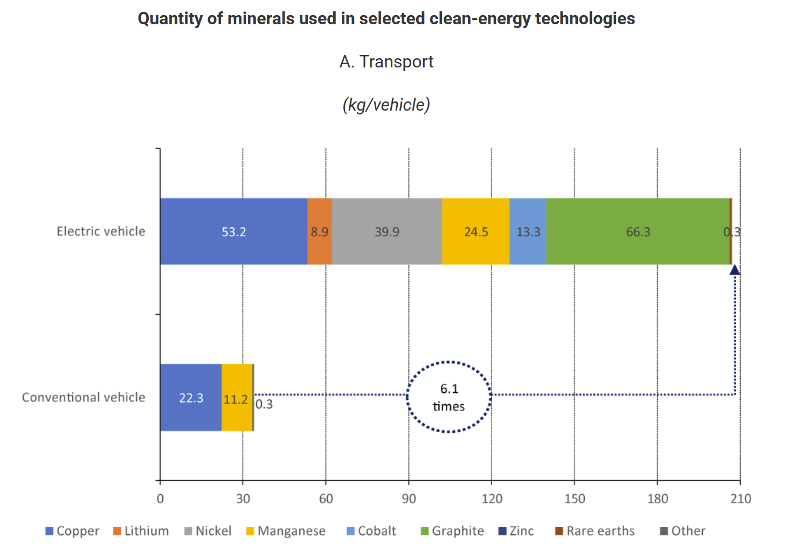
Source: CEPAL 2024
The extraction of lithium, currently considered the best solution for electric vehicle batteries, has brought high socio-environmental costs and political challenges (Donoso 2023). In the Andean salt flats of Argentina, Bolivia and Chile, the rapid extraction of lithium has affected traditional activities such as camelid herding and the cultivation of quinoa and maize that would take place in the areas where lithium is now being exploited (Aylwin 2025). Global Witness found that the rush for lithium in Africa risked fuelling corruption and environmental, social and governance problems (Global Witness 2023).
Figure 2. Global production of 6 CETMs by regionSource: UNODC 2025.
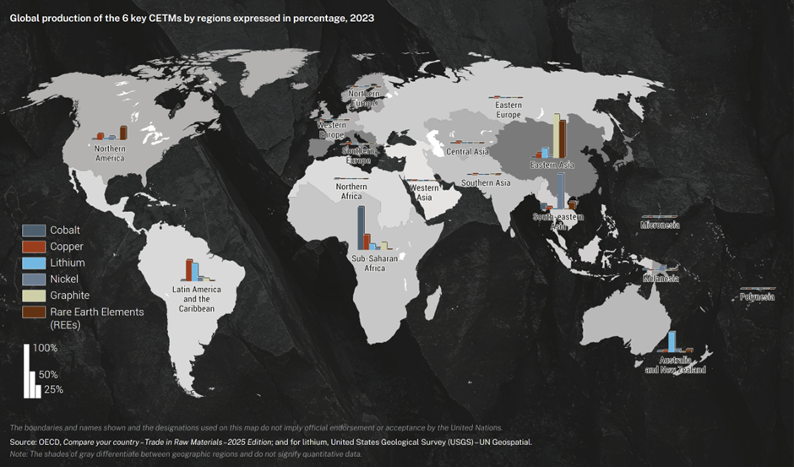
Source: UNODC 2025.
Figure 3. Shared of selected minerals in Latin America and the Caribbean
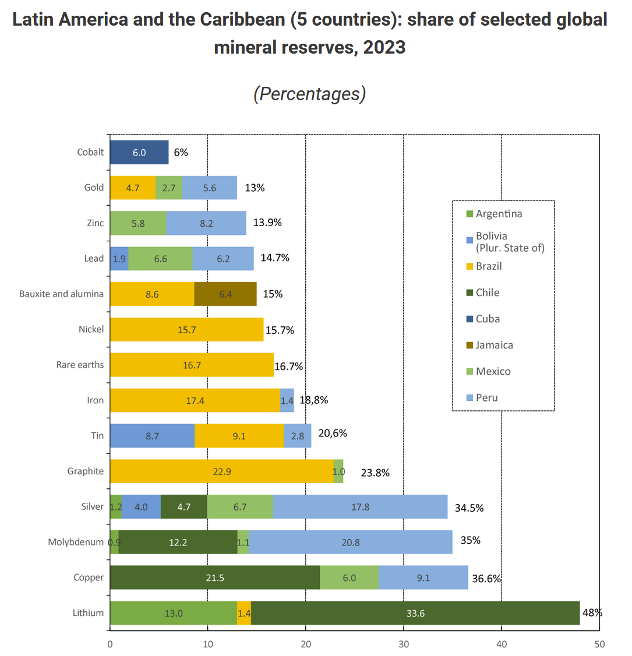
Source: CEPAL 2024.
CETMs are usually transported in large volumes, which means smuggling them relies not on concealment but on exploiting weaknesses, such as bribing corruptible officials and using false documentation and misdeclarations to take advantage of a lack of oversight (UNODC 2025).
In Zimbabwe, the production of lithium coincides with illegal trading, as companies mislabel shipments or underreport exports. Global Press Journal interviewed a former border agent who claimed he had accepted bribes to allow lithium shipments to pass through the border and that mining companies bribed border officials and sometimes also officers from the Revenue Authority and the Minerals Marketing Corporation of Zimbabwe (Mujuru 2025). According to the director of the Public Policy and Research Institute of Zimbabwe, the regulations surrounding the export ban of raw lithium are ineffective and there are officials colluding with politicians and foreign governments to facilitate illegal exports (Mujuru 2025). The government imposed the ban on raw lithium exports in 2022 in an effort to prevent artisanal mining (Reuters 2022).
Companies may also resort to corruption to circumvent regulatory requirements and speed up projects as demand for the minerals grows (UNODC 2025). In the Philippines, many mining companies have been linked to political figures, who then seek to influence regulations and leverage their influence to obtain mining subcontracts, while judges involved in cases brought against mining companies had to recuse themselves for conflicts of interest (Hindstrom 2025). Additionally, in Chile, a former economics minister was accused of taking illegal payments from a company to modify water regulations in favour of the lithium industry (Deutsche Welle 2018).
The extraction of critical minerals also increases the demand for land, resulting in land corruption risks and land grabbing and the forced displacement of communities without fair compensation or breaching prior informed consent requirements (Maslen 2023). This appropriation of land and resources for environmental ends can be called green grabbing and can involve new forms of commodifying nature (Leach 2012). In Zimbabwe, for example, lithium extraction has been found to lead to community displacements with no due diligence and without adequate processes of consultation and consent, often leaving communities impoverished (Matanzima 2024). The right to participation, consultation and consent has been regularly breached in lithium operations in the Andean salt flats (Aylwin 2025). For example, the Bolivian government signed a contract to extract lithium without first approving environmental studies and consulting the local communities, and claim these will be done afterwards (Mongabay 2025). Land grabbing can be facilitated by bribes, influence peddling, undue influence and policy capture (De Schutter 2016; Maslen 2023). In the context of CETM, high-level corruption has been linked to land allocation (UNODC 2025).
Another risk is associated with transparency in the supply chain. The conditions in some of these mines do not comply with minimal health standards or international obligations on child labour. For example, a 2017 Amnesty International investigation found children as young as seven working in artisanal cobalt mines, and none of the miners they saw wore masks to prevent breathing cobalt powder (Dummett 2017). As end users or even automobile factories demand ethically extracted CETM, corruption undermines transparency in CETM supply chains and is particularly present in the early stages of large-scale mining operations (UNODC 2025).
Processing raw materials
Most CETM refining is heavily concentrated in a handful of countries, particularly in China, where around 70% of the world’s lithium is refined (UNODC 2025). The literature does not often cover risks at this stage. However, as more countries promote investment in domestic processing facilities, states such as Namibia and Zimbabwe have already introduced a ban on unprocessed CETMs (Inside Climate News 2023), which could lead to more studies on these risks.
In Chile, a country that currently refines lithium, a national lithium commission formed in 2014 recommended preserving the strategic and non-leasable status of lithium and the creation of a state-owned enterprise (Yurisch Toledo et al. 2024). In 2023, the government presented a national lithium strategy that announced the creation of a state-owned company, but this has not yet been passed in congress (Yurisch Toledo et al. 2024). The fact that there are only two companies in Chile that have the capacity and knowledge to process lithium, they are in a privileged position. Terminating their operations or not renewing their licences could severely affect Chile’s revenue and standing as a lithium exporter, which could therefore lead to a risk of policy capture (Yurisch Toledo et al. 2024). Additionally, in Chile, there are risks regarding tax and revenue collection, a consequence of gaps in fiscal transparency and reporting in the industry and poor compliance with tax obligations (Yurisch Toledo et al. 2024).
The manufacturing of components and final product assembly
The manufacturing and assembling phases of the supply chain usually take place in countries other than the ones where the mining takes place. Most electric vehicle batteries are produced in China (Rory et al. 2026). China is also the world’s electric vehicle manufacturing hub, accounting for more than 70% of electric cars produced in 2024 (IEA 2025). Considering that most of CETMs are also processed in China, this makes the country a key player in the electric vehicle supply chain. The second-largest manufacturing region is the European Union (IEA 2025). China is the largest exporter of electric vehicles with 40% of global exports in 2024, followed by the EU. In 2024, Mexico also increased its export of electric vehicles to the United States (IEA 2025). However, this might change as additional export costs, like tariffs, and incentives from countries favouring domestic production have prompted Chinese companies to establish overseas manufacturing capacities (IEA 2025).
At this stage, the most salient risks are the use of forced labour and child labour (e.g. passport retention, recruitment related debt, forced overtime), the exposure of workers to hazardous chemicals, undermining collective bargaining, low wages and excessive overtime (OECD 2025a). While not corruption risks per se, corruption can be used to cover up abuses or hinder proper oversight. The sector relies heavily on the use of migrant and temporary workers who can be at heightened risks of forced labour (OECD 2025a). While there has been a focus on identifying and addressing risks linked to the extraction and production of raw materials, there is a lack of initiatives at the manufacturing and final product assembly phase to identify and make risks visible (OECD 2025a).
Figure 4. Lithium batteries global production capacity
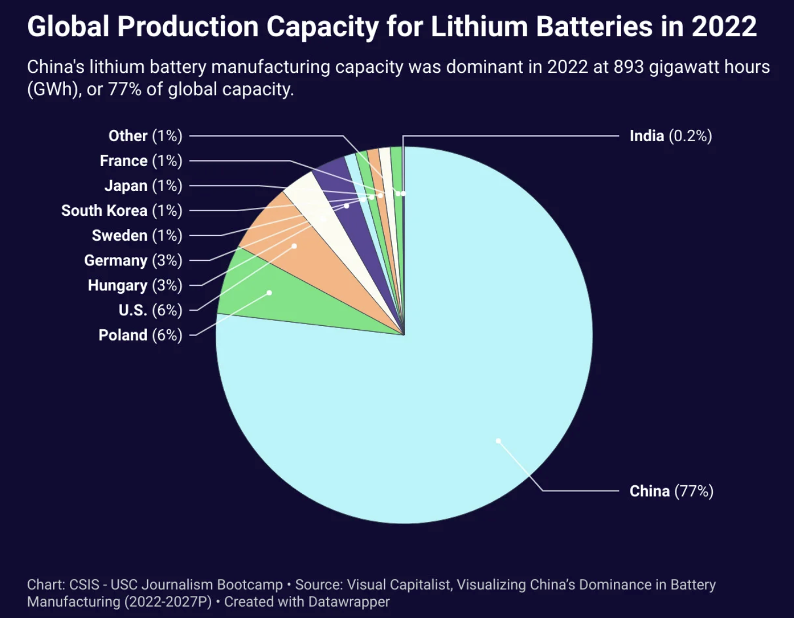
Source: Rory et al 2026.
Bribery and corruption have been linked to large-scale investments, favourable tax conditions and relaxed oversight (OECD 2025a). The OECD found the risks arose as: payments to regulators to avoid tax and operation investigations in the factories; payments to safety inspectors; payments to government officials in exchange for large investments; or mergers with local companies (OECD 2025a). In China, a government investigation found that some manufacturers would obtain vehicle operation licences, which are used to verify sales volume and distribute state subsidies, through bribing or deceiving local authorities (icct 2017). As a result of the investigation, the Chinese government reconstructed its electric vehicle subsidy policies to close any loopholes (icct 2017).
However, despite the corruption risks noted throughout the supply chain, electromobility also offers the possibility to reduce certain corruption risks in the transport sector, particularly regarding fuel. In Paraguay, where fuel is constantly stolen both in the private and public sectors, eliminating the dependency on fossil fuels in public fleets could reduce corruption linked to fuel management (Mobility Portal 2024).
The electromobility sector in Peru
Corruption risks in the extraction of critical minerals
Building on the risks identified in the extraction and production of raw materials above, Peru’s mining sector presents structural governance challenges directly relevant to the electromobility value chain.
Peru is the world’s second-largest producer of copper, a mineral essential for electric vehicles, charging infrastructure and electricity grid expansion. The country produced approximately 2.7 million metric tons of copper in both 2024 and 2025, with reserves estimated at 53 million metric tons, confirming its strategic position in the global copper supply chain (US Geological Survey 2026). Global projections indicate that copper demand is expected to rise significantly due to electrification, artificial intelligence infrastructure and energy transition technologies S&P Global 2026). As global demand for copper increases in the context of the energy transition, Peru could be positioned as a key supplier for electromobility related industries. This growing demand may intensify investment flows and pressure to accelerate extraction projects, potentially amplifying existing governance vulnerabilities if transparency, oversight and accountability mechanisms are not strengthened accordingly.
Although lithium extraction is not yet commercially developed at scale in Peru, the country is estimated to hold approximately 1.1 million tons of lithium resources (US Geological Survey, 2026). The most advanced lithium initiative to date is the Falchani project in the Puno region, described as the first and only identified lithium deposit in Peru, currently in the exploration and feasibility stage. While Peru is not currently a major global lithium producer, the presence of these resources – combined with Law No. 31283 (2021), which declared lithium a resource of public necessity and national interest – positions the country as a potential future supplier within the electromobility value chain.
The law grants the Ministry of Energy and Mining (MINEM) authority over lithium policy design and concession granting. In a context of fragmented oversight, limited enforcement capacity and weak inter-institutional coordination, this concentration of regulatory and concession authority may increase discretion and the risk of regulatory capture if lithium development accelerates without strengthened transparency, environmental oversight, beneficial ownership disclosure and traceability mechanisms.
A study by Proética (Proética 2019) on corruption risks in the mining sector identified structural vulnerabilities that remain relevant today. These include limited transparency in concession processes, insufficient disclosure of beneficial ownership information, weak inter-institutional coordination among supervisory authorities, and deficiencies in ensuring accessible and timely information for affected communities. The study also highlighted governance weaknesses surrounding the REINFO registry for small-scale mining, originally conceived as a temporary formalisation mechanism but repeatedly extended over time.
Reports have shown that individuals under investigation for illegal mining activities have been registered under REINFO, raising concerns about traceability mechanisms and oversight effectiveness. Although illegal mining in Peru is primarily associated with gold, the governance weaknesses it exposes – limited territorial control, criminal infiltration, weak monitoring systems and institutional fragmentation – illustrate structural vulnerabilities that could affect other minerals should their economic value increase in the context of the energy transition.
Media reporting and public debate have also pointed to political dynamics that may weaken oversight of illegal mining, including legislative initiatives perceived as reducing controls or delaying regulatory reforms. These developments suggest that corruption risks in the extractive sector may not be limited to operational enforcement challenges but may also involve regulatory and political dimensions that affect accountability frameworks.
Transparency gaps are also present in environmental governance. Limited public access to detailed environmental impact assessment (EIA) commitments and monitoring information reduces scrutiny during early project stages. In regions such as Puno, where lithium deposits are located, high levels of social conflict and limited institutional presence may further elevate risks if extraction advances without robust transparency, participation and accountability mechanisms.
Taken together, these factors suggest that the expansion of mineral extraction linked to electromobility, whether through increased copper production or future lithium development, should be accompanied by strengthened transparency frameworks, clearer allocation of supervisory responsibilities, improved beneficial ownership disclosure, reinforced traceability systems and safeguards against political interference in regulatory processes.
While extraction represents the upstream stage of the electromobility value chain, corruption risks in Peru’s transition to electromobility also emerge in downstream sectors, particularly in transport procurement and electricity regulation. These sectors are examined in the following section.
Institutional and regulatory development of electromobility in Peru
Peru has pledged to achieve net zero emissions by 2050 (Climate Action Tracker 2025). Reaching this objective rests on three main pillars: stopping and reversing deforestation in the Amazon forest, decarbonising transport and quadrupling the country’s electricity generation capacity from renewable resources (OECD 2025b). It is considered that 10% of Peru’s emissions can be attributed to transport (Osinergmin 2019). The most practical way to decarbonise the transport sector is to transition from gasoline powered vehicles to electric vehicles (otherwise known as electromobility) (Ndhlovu et al. 2025). To achieve net zero emissions the change in transport must also come with a shift in the energy matrix to ensure electric vehicles are charged with clean energy (Osinergmin 2019). While electromobility is still an emerging sector in the country, there is a growing demand for electric vehicles.
Electromobility implies the replacement of the technology currently used by most vehicles – internal combustion engines that run on fossil fuels – with electric engines (Osinergmin 2019). The transition to a transport matrix based on electromobility requires electric vehicles (that require CETM in their production), charging infrastructure that uses protocols and standards that allow access to all and an electronic network capable of providing electricity to the charging infrastructure. When deciding to buy an electric vehicle, users will consider the convenience, availability and accessibility of the charging infrastructure (Osinergmin 2019).
There are three levels of charging technology, depending on power and charging speed (Osinergmin 2019). The first two levels depend on the car charger, while the third one, fast charging, requires a bigger investment and takes the form of public charging centres, for example, along highways, malls and parking lots (Osinergmin 2019). However, most drivers around the world charge their vehicles at home or their working places (Osinergmin 2019). Electric vehicle charging infrastructure can be located in five broad categories of locations: corridors (e.g. highways); fleets; workplaces; general public/retail spaces; and homes/multifamily buildings (Kirshenberg et al. 2024).
The transition to a transport system based on electromobility demands the state to determine what new responsibilities this carries for its different institutions and a coordinated effort between the electricity system authority and the transport system authority (Osinergmin 2019). If the goal is to implement a massive electric transport system, the transport and the energy infrastructures will need to operate simultaneously (Osinergmin 2019).
The Peruvian Electromobility Chamber was established in 2024 to promote and increase the uptake of electric vehicles and clean technologies in the country. On their website, they set as a 2030 target to have 30% of electric vehicles in Peru, which is currently 5% (CPEM n.d.). In 2021, the automotive sector association (Asociación Automotriz del Perú), which focuses on all vehicles and not only electronic ones, released an electromobility plan for Peru, which included a policy proposal and a roadmap for this sector. The plan identifies the following incentives to promote electromobility: temporary reduction of ad-valorem tax, temporary reduction of the general sales tax and municipal promotion tax, reduction of motor vehicle tax, increase of the tax on CO2 emissions fuels, a differential rate for residential charging of electric vehicles, preference for electronic buses in tenders for public transport, fiscal credits for electronic fleets and charging infrastructure, investments in charging infrastructure and establishing rules for charging points in parking lots (Asociación Automotriz del Perú 2021:8).
For its part, the Peruvian state is also looking into various funding schemes for the transition towards electromobility. In 2024, the Ministry of Transport and Communications presented a proposal to improve transport efficiency and sought support from the World Bank to promote the provision of electric vehicles to the capital’s transport system (La República 2024a). Peru also signed a loan with KfW Development Bank to develop sustainable urban transport, which included support for the installation and operation of charging infrastructure (Mobility Portal 2023). On a visit to China in 2024, the transport and communications minister presented Peru’s interest in replacing public transport units with electric vehicles in an effort to explore an agreement with the Chinese government to secure funding (gob.pe 2024). In 2025, the Transport and Communication Ministry announced a programme to promote the renovation of buses for more sustainable models through economic incentives to promote the renovation of old buses to electronic or hybrid vehicles (Mobility Portal 2025b).
Nonetheless, while the country has seen a surge in the sales of electric vehicles (133% in 2024), there is still no regulation framework for this type of vehicle despite more than 20 law initiatives presented to congress over the years (Mobility Portal 2025a). In 2024, a draft for a regulatory framework to promote and implement electric transport was approved by the economics committee in congress, but it was archived afterwards. Sources in the sector mentioned to Mobility Portal that progress was thwarted by a lack of consensus between the two key ministries, the Energy and Mining Ministry and the Transport and Communications Ministry (Mobility Portal 2025a),
While there’s no one overarching framework, there are some legal instruments that currently apply to the sector. The technical norm NTP-IEC 61851-1:2020 from the production ministry (PRODUCE) applies to charging conductive systems for electric vehicles (gob.pe 2025c). The technical document contains requirements for electronic charging infrastructure which applies to electric vehicles and hybrid vehicles that can be plugged in (gob.pe 2025c). The norm seeks to harmonise safety and compatibility criteria between producers, interoperability and efficiency (gob.pe 2025c). The national vehicle regulations (Reglamento Nacional de Vehículos) was modified in 2018 and now applies to electric vehicles as well as traditional fossil fuel ones (DS N 019-2018-MTC). While it does not provide detailed guidelines, it includes new definitions and stipulates that electric vehicles that provide taxi services need to have a minimum autonomy of 200 kilometres and a potency of 80kW or more (Osinergmin 2019).
The country has also adopted measures to promote electronic ground transport to achieve lower emissions. In 2015, the Ministry of Energy and Mining launched a nationally appropriate mitigation action (NAMA) that has an objective to promote public policies for the use of sustainable energies through the mass adoption of electric vehicles (Osinergmin 2019). Similarly, the Ministry of Economy and Finance in coordination with the Environment Ministry increased taxes on fossil fuels according to their level of harm to the environment (Decreto Supremo N 094-2018-EF). Electric vehicles have an excise duty of 10% compared to 20% applied to diesel vehicles (Osinergmin 2019). In 2020, supreme decree N 022-2020-EM specified the definition of electromobility (as ground transport that uses one or more electric engines to generate locomotion) and stipulated that the service of charging batteries for electromobility: has a commercial character; is to be carried out in free competition; is of public access; and to be provided at the national level (Echecopar 2020). The decree further details that the responsibility for the supervision of charging infrastructure will fall under Osinergmin (supervising agency for investment in energy and mining) while the audit of the technical and safety norms of this infrastructure will be performed by the municipalities (Echecopar 2020).
While the boom in electric vehicles is recent, with few best practices and learned lessons yet, countries in the region have already started implementing their own frameworks. Furthermore, existing regulations and policies tend to focus more on how to incentivise the adoption of electromobility as countries seek to reduce their emissions. The United Nations Economic Commission for Europe differentiates between push and pull policies to drive electric vehicle demand (UNECE 2025). Pull policies refer to incentives, like tax reductions or subsidies, while push policies include more restrictive measures like low-emission zones and planned restrictions on internal combustion engine vehicles (UNECE 2025).
In China, policies implemented in the context of electric buses were tax reductions for urban public transport, safety supervision of electric vehicles, subsidies for acquiring electric buses for public transport and the replacement of combustion vehicles with electric vehicles in public service fleets (Kraemer et al 2023).
In Europe, the European Union’s clean vehicles directive, adopted in 2021, promotes non-polluting mobility solutions in public tenders, defines clean vehicles (based on their emissions) and sets national targets for their procurement. The European block’s policies and directives can be divided into vehicle standards, recharging infrastructure and vehicle targets, building construction regulations, financing for the electromobility ecosystem, charging technical standards and development of the battery production chain (Kraemer et al. 2023).
In Latin America, Bogotá, in Colombia, incorporated innovations into public transport contracts which made it easier to obtain financing from financial institutions for electric buses (Kraemer et al. 2023).
In terms of the energy and charging infrastructure, strategic planning and targeted investments are needed for it to be effective (UNECE 2025). Efforts like Germany’s charging infrastructure masterplan support interoperability standards, reliability criteria, financial mechanisms and mandates for coverage that ensure a robust and accessible charging network that can meet user needs (UNECE 2025).
In Santiago, Chile, their model involved manufacturers, automakers and a financial institution, and the financial institution’s role is fulfilled by energy companies instead of banks, making sure there is energy supply for the whole system (Kraemer et al. 2023). In Brazil, the ANEEL normative resolution No. 1.000/2021, which consolidates the rights and duties of electricity consumers, stipulates the provisions of the installation of electric vehicle chargers (Kraemer et al. 2023).
Collaborative governance is key in this sector, as well-designed public-private partnerships, joint ventures and collaborative platforms allow government bodies, private companies and civil society organisations to pool funds, manage risks and align strategies (UNECE 2025).
Ground transport sector in Peru
Ground transport and transit in Peru are regulated by law 27181, which was last amended by a legislative decree published on 30 January 2026, promoting the integrated transport system. The law stipulates that the state incentivises free and loyal competition in transport, protects the interests of transport users, focuses its actions on transport markets that present distortions or limitations to free competition and can establish temporary measures to renovate the fleet. The law designates the Ministry of Transport, Communications, Housing and Construction as the governing body in ground transport and transit. The ministry and provincial municipalities are responsible for granting licences, permits and authorisation to the transport services that fall under each jurisdiction according to national norms.
The Ministry of Transport and Communications has an institutional integrity model based on the national integrity and fight against corruption policy (decreto supremo n° 092-2017-PCM), the anti-bribery policy in the sector of transport and communications (ministerial resolution no. 614-2021-MTC/01) and the ethics code of public service (law 27815). The integrity model has nine components: 1) high-level commitment; 2) risk management; 3) integrity policy; 4) transparency; 5) control and audit; 6) communication and training; 7) reporting channel, 8) monitoring and supervision; and 9) responsible for the integrity model.
Additional relevant legal frameworks include:
- reglamento nacional de administración de transporte (decreto supremo no. 017-2009-MTC) regulates the service of ground transport of people and goods.
- reglamento nacional de vehículos (decreto supremo no. 058-2003-MTC) contains the characteristics and technical requirements relative to security and emissions that vehicles need to comply with to enter the national transport system. It also states the procedures for vehicle inspection.
- superintendence of ground transport of people, cargo and freight (SUTRAN) is the entity in charge of the prevention, audit and sanction of ground transport activities of people, cargo and freight. Its mission is to protect the lives of transport users in an efficient and transparent form.
While not specific to electromobility, any rapid expansion of infrastructure and public services can exploit existing vulnerabilities across procurement processes, public bidding and public-private partnerships in the country. These areas can pose higher risks of corruption, especially when applied to a sector that lacks clear regulations and technical standards. Furthermore, corruption has been identified as a major obstacle to the development of urban transport infrastructure (Gestión 2019). The following subsections cover these broader risks in ground transport and big projects in Peru.
Procurement and bidding risks
Corruption in public procurement is considered to be common in Peru. A study by the comptroller’s office found that 40% of contracting expenditure happened under non-competitive modalities, i.e. goods and services contracted by the public sector where there was no competition from other budgets (Contraloría General de la República 2024b). The same study found that 54% of public entities had contracts with at least one provider that was disqualified from contracting with the state (Contraloría General de la República 2024b).
For example, the “Club de la Construcción” scheme, which operated primarily between 2011 and 2014, involved a collusive agreement between the country's leading infrastructure firms to distribute public work contracts among themselves. Each time there was an open bid for a project, the companies agreed who among them would win and then informed a public officer in the Ministry of Transport and Communication of the decision, who would then promote the chosen bid and help it win in exchange for a bribe, which in most cases was between 1% and 3% of the contract amount (Idehpucp 2020b). This bribe is thought to have come from overcharging in the projects, which meant that the state ultimately paid for the bribe (Idehpucp 2020b). One of the companies involved in this case entered a plea bargain with public prosecutor’s office, and the consumer’s defence institute fined the involved companies (El Comercio 2019; 2021).
The comptroller’s office also found irregularities in the implementation of the transport information management system in Cusco, with the local government purchasing software to suppliers that did not meet the terms of reference, which generated a US$62,000 loss, among other public purchases with anomalies (gob.pe 2025a).
Public-private partnerships
Electromobility will require the development of more electric vehicle charging facilities. The initial investment required for those might be a barrier, especially in less urban areas (Kirshenberg et al. 2024). This may lead to public-private partnerships to ensure that charging facilities are developed throughout the territory (Kirshenberg et al. 2024).
In Peru, public-private partnerships are a form of private investment participation based on long-term contracts that involve the state – through a public entity – and one or more private investors (Proinversión n.d.). The idea behind these agreements is that the public and private sectors share risks and resources to develop public infrastructure and public services of quality (Proinversión n.d.). Depending on the nature, scope and contract of the project, the ownership of these investments may be retained by the private party, reverted or transferred to the state (Proinversión n.d.).
A 2022 comptroller’s office study on public-private partnerships in Peru examined the different risks associated with the negotiation of addendums and made a series of recommendations to minimise the possibility of a re-negotiation once the partnership had been signed (Contraloría General de la República 2022). The in-depth study covered renegotiations in ten contracts of different sectors, including both transport (road infrastructure) and electric generation and transmission. While the study covered risks beyond the ones related to corruption, the re-negotiation of contracts entails corruption risks similar to those of the negotiation phase. For example, during the partnership negotiations, corruption risks can include: bribing public officials so they favour a particular company, which can be prevented by identifying conflict of interests, ensuring a third-party examines the selection process and the conditions; establishing clear budgets from the offset; and ensuring officials have the necessary skills (Contraloría General de la República 2022).
While most addendums are not the product of corruption nor entail corrupt acts, in Peru, corruption was suspected in various major contract renegotiations over the years. A former mayor of Lima was investigated for collusion, incompatible negotiation, influence peddling, active laundering and illicit association in the addendums to a major road infrastructure project (Idehpucp 2020a). Investigations done by the press reported that a transit by-pass and a park that were part of the addendum were made without any technical studies to support them and showed serious irregularities (Cárdenas 2018).
The study also found that 46% of the public-partnerships studied had addendums in their first three years of operation, which was early in the partnership considering their average length was 27 years (Contraloría General de la República 2022). In some cases, the contract design phase lacked adequate preliminary studies (such as feasibility, basic engineering, environmental and geological), creating uncertainty and affecting the proper identification of risks leaving the state with more risks (Contraloría General de la República 2022). This sometimes led to increased costs for the state as some of these partnerships lacked a proper study of how much a particular project could cost to inform the selection process (Cárdenas 2018). This allows for “aggressive bidding”, where companies present very low-cost proposals and then renegotiate the terms of the contract once they are awarded the projects (El Comercio 2017).
Corruption risks in the electricity sector in Peru
Switching the transport matrix from combustion engine vehicles to electric engine vehicles will affect the electricity supply. In 2024, the electricity consumption of the global fleet of electric vehicles was almost 60% more than the previous year with electricity demand potentially increasing four times by 2030 thanks to electric vehicles (IEA 2025). Some projections estimate that electricity demand will exceed the supply due to flee electrification as these trends might require new power plants (MIT News 2023; Ruoso et al. 2024). In this sense, increasing the electric fleet in Peru has the potential to further exacerbate corruption risks in this sector.
The process of delivering electricity requires the following chain: i) generation: the transformation of the energy source (fossil fuels, natural resources or nuclear) into electricity; ii) transmission: transportation to large load centres; iii) distribution: a network to connect and supply electricity to end users; and iv) supply: commercial transactions to recover the value from end users (Asian Development Bank 2009). The energy system needs regulation due to its complex characteristics. Weak regulations in the energy sector can lead to market monopolies and neglect of environmental and social standards (Transparency International Indonesia 2024). Moreover, electricity is both a good and a service, and the electronic system requires major infrastructure and operational coordination to guarantee transmission from generation to consumption (Transparency International España 2014).
The Peruvian state needs to determine who will have the role of providing the charging infrastructure and prepare the regulatory and institutional framework for these new roles (Osinergmin 2019). Furthermore, transversal approaches and coordination between the transport and energy sectors need to be promoted from the government (Osinergmin 2019).
One corruption risk that arises in the context of regulation of energy is the phenomenon of revolving doors, which refers to the movement of individuals between public office, particularly in regulatory and legislative positions, and private companies. Revolving doors can lead to the prioritisation of private gain over public interest and regulatory capture, a situation where regulatory agencies are co-opted by the industries they are meant to regulate (Sustainability Directory 2025). In Spain, for example, revolving doors between the government and the fossil fuel industry caused harm by leading to climate inaction (Pons-Hernández 2022). In Peru, a newspaper reported that the reluctance of the oversight organism for energy and mining (Osinergmin) to comply with an order to end price distortions in electronic energy could be traced back to a revolving door between the entity and electronic companies (La República 2024).
The energy sector was not spared from the Lava Jato scandal and in 2019 it was revealed that Odebrecht had recognised illicit payments related to the tender of a gas pipeline in the south of Peru, Gasoducto Sur Peruano (Idehpucp 2020c). The project, which was valued in more than US$7 billion, has been paralysed for more than eight years (gob.pe 2014, 2025a).
Mitigation measures
Strengthening supply chain due diligence is key for reducing corruption risks across the electromobility value chain. Global guidance and industry initiatives emphasise the importance of transparency, traceability and regular assessments to ensure CETMs are sourced responsibly. While there are no specific recommendations for Peru in the sector of electromobility, these recommendations can largely be applied to the Peruvian context as it promotes the uptake of this technology. Peru’s comptroller’s office has provided a set of recommendations to mitigate corruption risks in in public-private partnerships that could be applied to new partnerships in this sector. Furthermore, Peru can also apply some of the recommendations on the mining of CETMs to its own context as the country is the world’s second-largest exporter of copper (UNODC 2025).
Supply chain due diligence
Private sector actors need to play a role in addressing corruption risks both in their operations and in the supply chain of minerals (G20 Anti-Corruption Working Group 2022). Mitigation measures for the early stages of the electromobility supply chain focus on responsible and traceable mining of CETM. Electromobility manufacturers can reduce corruption risks in their supply chains by working with suppliers that have strong transparency and accountability systems. They can conduct due diligence and seek suppliers that disclose contracts, licences, government payments and beneficial ownership; maintain independent ethics and compliance oversight and enforce strict disciplinary and remediation processes (Elkind & Fitzgerald 2023; Morrison Foerster 2024). Traceability is thought to clean up the supply chain and make sure the mining of minerals aligns with international environmental, social and governance standards (Reuters 2025).
Global Witness recommends applying a risk-based approach across the entire value chain, beyond direct business relationships (Hindstrom 2025). Companies can review suppliers past records and any corruption allegations to understand if and how they were addressed and make an informed decision when deciding whether to buy from a supplier (Elkind & Fitzgerald 2023).
Additionally, the Responsible Cobalt Initiative (RCI) is a China-led governance initiative launched in 2016 which involves a number of companies, including Apple Inc., HP Inc., Huawei Device, Samsung and Sony. The OECD is engaged in this initiative through its responsible minerals implementation programme (RCI 2016). The RCI aims to have downstream and upstream companies align their chain policies with the OECD due diligence guidance for responsibly supply chains of minerals from conflict-affected and high-risk areas and the Chinese due diligence guidelines for responsible mineral supply chains to increase transparency in the cobalt supply chain (RCI 2016). It also promotes cooperation with the government of the Democratic Republic of the Congo (DRC), civil society and affected communities to address the risks and challenges in the cobalt supply chain (RCI 2016).
The initiative developed a complaint and consultation mechanism for the mining industry and mineral value chain, which seeks to improve the handling of disputes on environmental, social and governance issues related to mining projects and mineral supply chains (Global Witness 2022). Automakers and fleet purchasers can use resources such as the Responsible Cobalt Initiative when identifying suppliers (Elkind & Fitzgerald 2023).
Companies can include commitments to conduct risk-based due diligence, and management is encouraged to allocate the appropriate resources for this (OECD 2025a). The OECD (2025a) recommends due diligence encompass first a high-level scoping exercise identifying where impacts can be more severe and/or more likely. Companies may want to seek collective action and multistakeholder initiatives to increase the success of mitigation measures (OECD 2025a).
Public procurement
Collaborative approaches, outreach and commercial incentives have the potential to increase the leverage public buyers can exert in public contracts (OECD 2025a). The Cobalt Institute, for example, seeks to bring together the entire value chain to promote the sustainable, safe and responsible production of cobalt. Its members do not employ or incentivise artisanal or child labour in their operations or supply chains. Governments can incorporate strong anti-corruption provisions into mining projects, in policies and legislation addressing responsible sourcing and due diligence (Elkind & Fitzgerald 2023). The EU’s critical raw materials regulation, in force since 2024, sets out sustainability criteria for strategic projects in mining, refining and processing inside and outside the EU, including anti-corruption requirements (Fitzgerald et al. 2024).
Reforms to reduce corruption risks in the mining sector include public beneficial ownership registries, as Armenia and Indonesia have created after piloting them in the extractive industries (OGP n.d.). Argentina implemented a system with open information on mining activity (SIACAM), led by the national mining secretary (OGP 2023). This platform, created in 2022, centralises in one place all open data regarding economic, geological, social, sanitary and environmental issues in the mining sector, as well as payments made by mining companies to the national government (OGP 2023). Artisanal mining can also improve its standards. The DRC, for example, has started producing traceable artisanal cobalt to start formalising the sector (Reuters 2025).
In terms of public-private partnerships for the development of charging infrastructure, Kirshenberg et al. (2024) considered that ideally one single private entity is responsible for the design, financing, operation and maintenance of the charging station, and this entity collects revenues directly from users. The public agency can provide financial support though a direct subsidy (likely performance based), a de-risking mechanism (e.g. a minimum revenue guarantee or a revenue sharing mechanism) or a combination of both (Kirshenberg et al 2024). It can contain a provision to allow the public agency to reprocure the site after the arrangement has expired (Kirshenberg et al. 2024).
In Peru, the comptroller’s office has developed a series of recommendations to mitigate corruption risks in public-private partnerships which include the auditing of the process of advertising, selection and implementation of public-private partnerships to foster transparency, make risks visible and create internal controls to prevent corruption (Contraloría General de la República 2022). If the press and civil society have access to the addendum process, it makes it more difficult for corruption to arise (El Comercio 2017).
Governments can ensure transparency and governance in the renewable energy sector and efforts to do this include creating or strengthening supervisory functions and taking measures to mitigate corruption risks (G20 Anti-Corruption Working Group 2022). Policymakers and advocates can incorporate anti-corruption into benchmarks or reports on companies’ sustainability provisions and responsible sourcing and encourage stakeholders to consider corruption allegations when making supplier decisions (Elkind & Fitzgerald 2023).
Public procurement can also be an opportunity to mitigate human rights and environmental risks, thus reducing the associated corruption risks. One way to do this is through supplier dialogue, which supports public buyers to move from a transactional relationship toward a cooperative one where they can use their leverage to mitigate risk and address issues before they escalate into actual violations (Electronics Watch 2025). For example, the low-emission vehicles programme assists participating public buyers in building their capacity to implement responsible procurement and promoting and protecting rights of workers along the supply chains (Electronics Watch 2025). The programme also allowed participants to use collective leverage to increase standards and promote accountability (Electronics Watch 2025).
Other recommendations include prioritising quality standards and levels of service as criteria for awarding contracts to establish impact indicators to measure the effects of the project in the well-being and quality of life of users (Contraloría General de la República 2022). This last recommendation was considered key by the study as it would widen the focus of public-private partnerships from investment and return to include the benefits the infrastructure or service could provide the citizens (Contraloría General de la República 2022).
Peru passed a law to prevent and mitigate conflicts of interest in the entry and exit of public service, law N. 31564 (gob.pe 2022). The law’s regulations establish that public officials, whether elected or designated, cannot work for private companies over which they had jurisdiction while they are in office and within a year after leaving office (Gestión 2023).
Renewable energy
If electromobility is to truly curb the country’s emissions, it will need to be accompanied by a transition of the electric matrix to non-fossil fuel. Renewable energy initiatives can benefit from understanding the specific context in which they will operate (Gokce & Jones 2018). The types of corruption risks may vary depending on the type of renewable energy. For example, Sovacool (2021) highlights that hydropower projects can be vulnerable to corruption because of their size, complexity and the large investment they require. Mitigation measures can include, among others, clear procedures and transparency requirements to reduce corruption risks in the award process, using agreements to bolster transparency mechanisms, transparency platforms for the sector and managing potential backlash from fossil fuels lobbyists (Gokce & Jones 2018; Rahman 2020).
Digital solutions and oversight
In Chile, the Energy Ministry launched the electromobility platform, with the aim of transferring knowledge and close information gaps to prepare the country for the mass use of electric vehicles (Energía n.d.). Its public-private agreement for electromobility aims to generate a space where various institutions can discover each other’s initiatives and make progress in a collaborative and coordinated fashion. Their 2025 agreement counts 175 companies and institutions and, while it does not contemplate integrity or specific corruption mitigation measures, such a platform could help launch integrity pacts in the future.
Peru has also made important progress on various fronts. The Sistema Electrónico de Contrataciones del Estado (SEACE) provides a platform for the public to monitor procurement processes and the Plataforma Digital Única de Denuncias del Ciudadano, allows citizens to report corrupt acts anonymously or, if they decide to identify themselves, ask for protection measures from the state. As part of measures to prevent future Lava Jatos, Peru has implemented anti-corruption clauses in contracts for big infrastructure projects, which now include the dissolution of the contract if corrupt acts were related to its award (Cárdenas 2018).